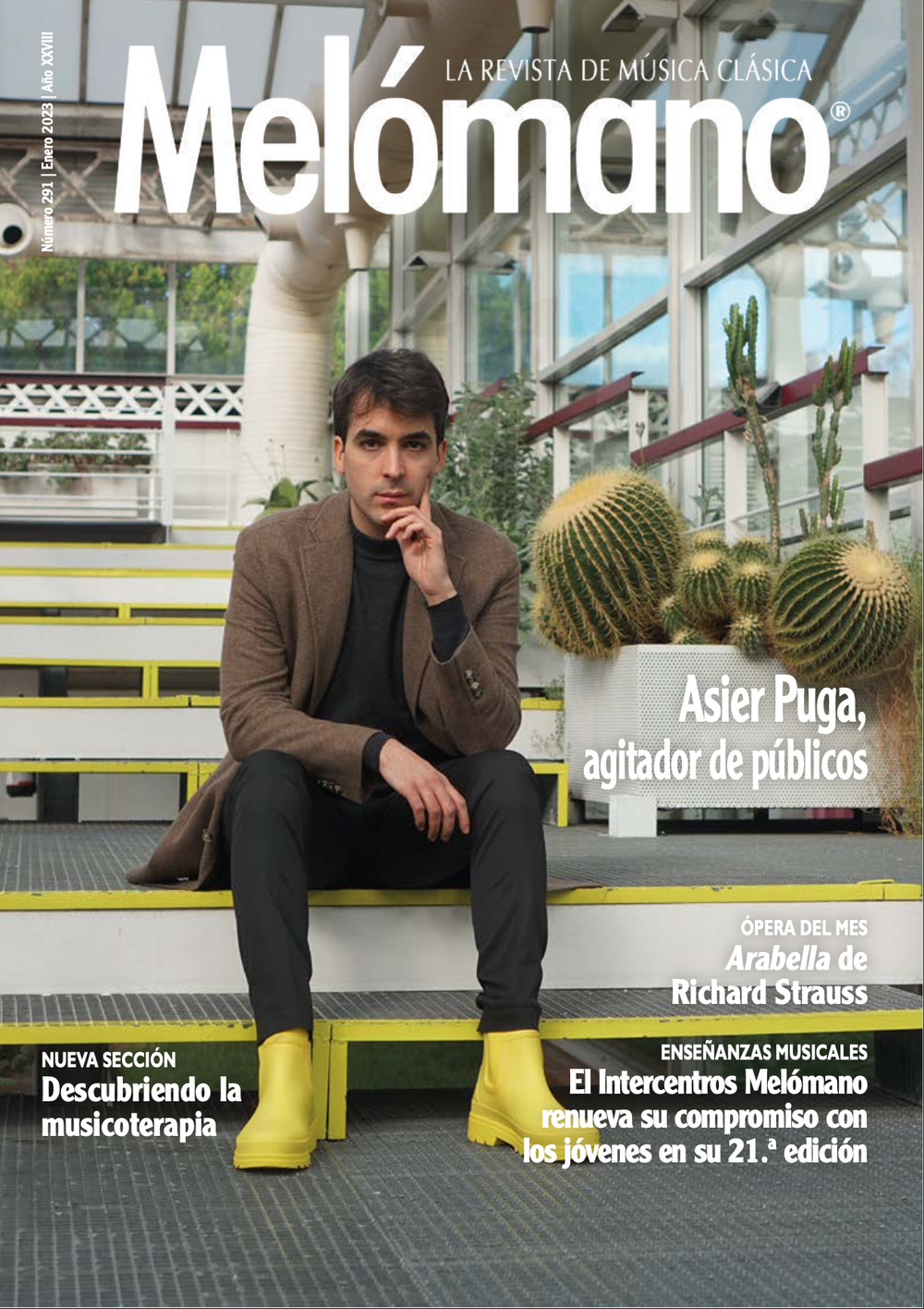
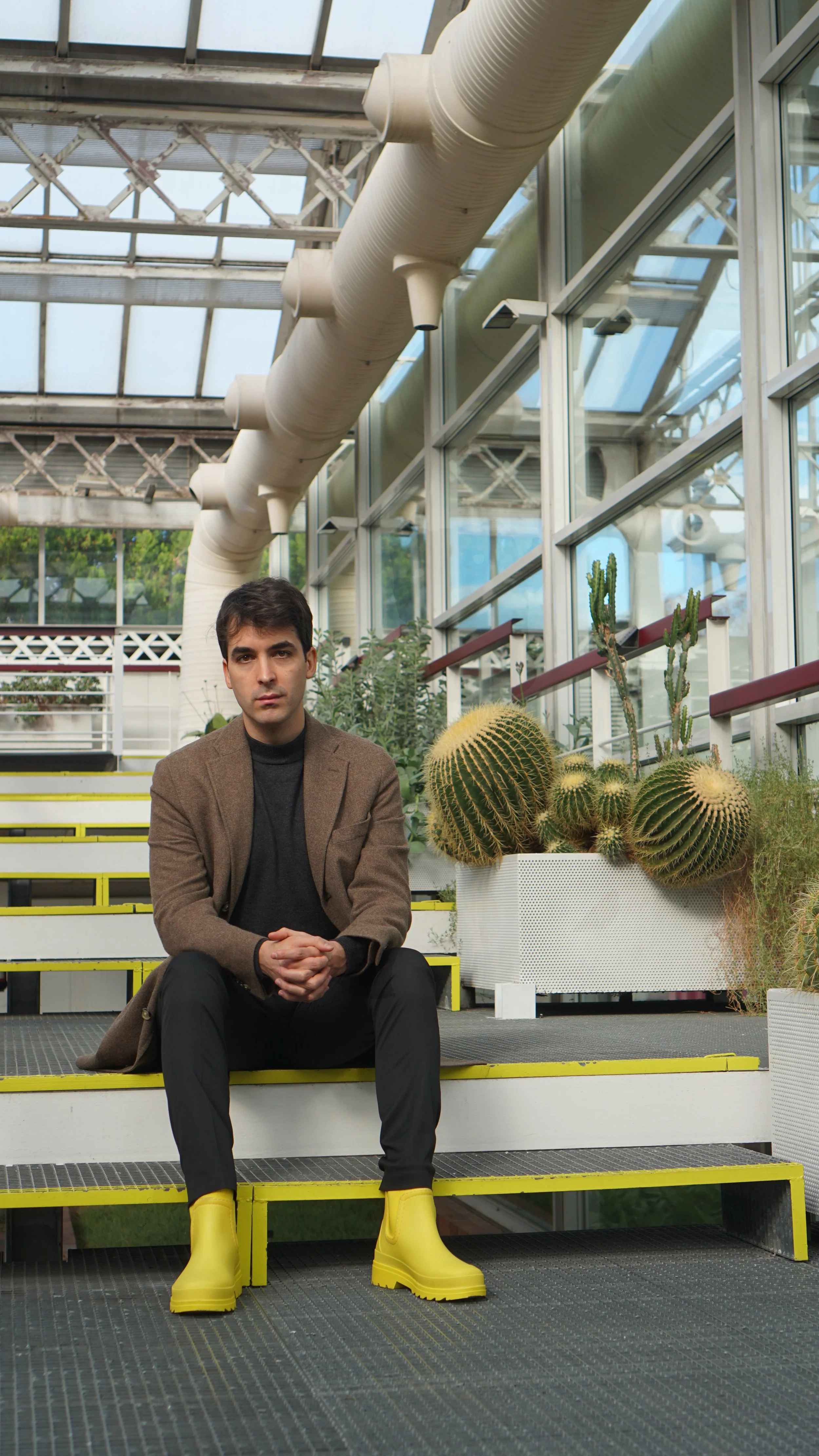
Asier Puga
Described by critics as one of the iconoclasts of contemporary Spanish music, Berlin-based conductor and creator Asier Puga has developed a singular artistic practice that transcends the conventional boundaries of conducting. Grounded in an expanded understanding of the discipline, his work articulates an ongoing dialogue between musical practice, performance, and contemporary and stage expression, shaping each concert as a laboratory where tradition is placed in tension with the present.
Principal Conductor and Artistic Director of Grupo Enigma—the resident chamber orchestra of the Auditorio de Zaragoza and one of Spain's most cutting-edge contemporary music ensembles—and founder of the artistic company Klang, his trajectory is defined by a dual commitment to musical interpretation and transdisciplinary creation. He trained as a conductor at the Royal College of Music in London, graduating with the highest distinction, and further developed his practice through masterclasses with figures including Pierre Boulez and Diego Masson.
As a conductor, he has collaborated with diverse orchestras and ensembles including the Orquesta Sinfónica de Castilla y León, Ensemble Itinéraire (Paris), Orquesta Sinfónica de Euskadi, Ensemble Ascolta (Germany), Orquesta Sinfónica de Bilbao, London Sinfonietta Academy, Explore Ensemble (London), Frames Percussion, Taller Sonoro, Covent Garden Chamber Orchestra, RCM Philharmonic Orchestra, among others.
Asier has performed at major international festivals and venues including the Festival d’Avignon, Bozar (Brussels), La Bâtie Festival (Geneva), Palau de la Música Catalana, Palazzo Grassi (Venice), Auditorio de Zaragoza, Auditori de Barcelona, Festival Internacional de Teatro Clásico de Mérida, Auditorio Nacional, Teatros del Canal (Madrid), Kings Place (London), Auditorio 400 Museo Reina Sofía, Auditorio Kursaal, Palau de la Música de Valencia, Espacio Turina, Quincena Musical de San Sebastián, Palacio Euskalduna, Fundación Juan March, Britten Theatre, Festival Carmelo Bernaola, Amaryllis Fleming Concert Hall, and the Guggenheim Museum, among others.
Yet his practice is equally shaped by a profound engagement with the scenic and performative realm. Far from conceiving conducting in a traditional sense, Puga approaches his métier from a transdisciplinary perspective, placing music in dialogue with contemporary artistic and performative practices.
This expanded understanding of artistic practice has led him to collaborate with figures such as choreographer, dancer, and visual artist La Ribot—co-directing Juana ficción, premiered at the 78th Festival d'Avignon—as well as actor Juan Loriente, cantaor and multidisciplinary artist Niño de Elche, filmmaker María Ruido, and composer and sound artist pioneer Llorenç Barber. Together, they have developed works in which artistic languages intertwine, contaminate, and overflow one another.
His interest in the voice has likewise informed a substantial body of work in music theatre and opera. He has collaborated with singers including Carlos Mena, Astrid Nordstad, Maria Schellenberg, and Alejandro del Cerro, as well as numerous choral ensembles. His operatic and staged productions encompass works such as Armida (Haydn), Albert Herring (Britten), Die Fledermaus (Strauss), West Side Story (Bernstein), Laborintus II (Berio), Rothko Chapel (Feldman) and Oresteïa (Xenakis), for which he wrote the libretto for the production that opened the Festival Internacional de Teatro Clásico de Mérida in 2023.
In recent years, his work as a stage creator has assumed an increasingly central place within his artistic practice. Recent projects include Petrolio (2025)—for which he conceived the adaptation, artistic concept, and music direction, with music by Carlos de Castellarnau, based on Pasolini's unfinished novel—as well as a transdisciplinary re-reading of Treatise (2026), Cornelius Cardew's legendary graphic score; an eight-hour happening inspired by Andy Warhol's epic film Empire; and a new interpretation, developed alongside Llorenç Barber and Montserrat Palacios, of John Cage's celebrated lecture-performances of the 1950s.
In 2026, he was invited by the Swiss haute couture house Akris to create the musical dramaturgy for its Autumn collection show at Paris Fashion Week, presented at the Palais de Tokyo. It is therefore unsurprising that both his artistic work and his curatorial projects reveal the breadth and complexity of his interests. His interest for literature and critical thought has led him to devote concerts, commissions, and entire seasons to authors and works such as André Breton’s First Manifesto of Surrealism, Paul B. Preciado, Rabelais’ Gargantua, Gilles Derrida, Susan Sontag, Arthur Rimbaud, Pier Paolo Pasolini, Philippe Sollers, Oscar Wilde, Aeschylus or William S. Burroughs, among others.
Deeply committed to contemporary music, Puga has conducted more than one hundred world premieres across Spain, the United Kingdom, France, and Switzerland. He has worked with composers including Chaya Czernowin, José Manuel López López, Núria Giménez-Comas, Sergej Newski, and Lisa Illean, while also leading the first performances in Spain, France, Italy, and the United Kingdom of works by Clara Iannotta, Tristan Murail, Rebecca Saunders, Olga Neuwirth, Bernd Alois Zimmermann, Carola Bauckholt, and others. He has made several recordings, including an album devoted to the music theatre works of Iñaki Estrada and a monographic album dedicated to the music of Núria Giménez-Comas, recorded with Paris's Ensemble Itinéraire for Neu Records.
Alongside his artistic activity, he has maintained an essayistic practice, having contributed to publications on music and contemporary art, including Sonograma Magazine and the blog of L’Auditori de Barcelona.
Asier currently lives between Madrid and Berlin and maintains an international artistic practice.
Interviews
Sul Ponticello:“Interview with Klang Company” by Joan Gómez Allemany.
Melómano. La revista de música clásica: “Asier Puga, Challenging Audiences” by Susana Castro.
Hémisphère Son: “Asier Puga, a Chef Turned Towards the Future”, by Chema Seglers.
Sonograma Magazine: “Interview with Asier Puga“ by Carme Miró.
Atónitos Huéspedes: “Asier Puga, a Revolutionary Classicist”, by Christian Peribáñez.