Oresteïa, Iannis Xenakis (2023)
Aeschylus’ Oresteia, written in the 5th century BCE, is one of the greatest masterpieces of ancient Greek theatre and the only surviving trilogy from that period.
In 1966, the Greek playwright Alexis Solomos commissioned Iannis Xenakis to compose the music for a new production of the Oresteia. Thus began a collaboration driven by the ambition to reconstruct, through the lens of their own time, the sounds of ancient Greece.
“Ancient drama cannot be expressed through tonal or atonal music such as serialism. That kind of music belongs to another era,” explained Xenakis, who created a fascinating score rich in contrasts and colours. “Collective songs and dances, invocation of Jupiter: order = disorder, madness, cries, metals, voices with different rhythms…” Xenakis wrote in the score. In several letters to Solomos, he also explained that the hysterical and chaotic interpretation of the chorus sought to evoke sounds similar to those of the demonstrations against the Italian and German occupations in Greece during the 1940s.
The work oscillates between the conflicts of Greek tragedy and those of twentieth-century Greece, between balance and chaos, all within an atmosphere of a modern primitive ritual.
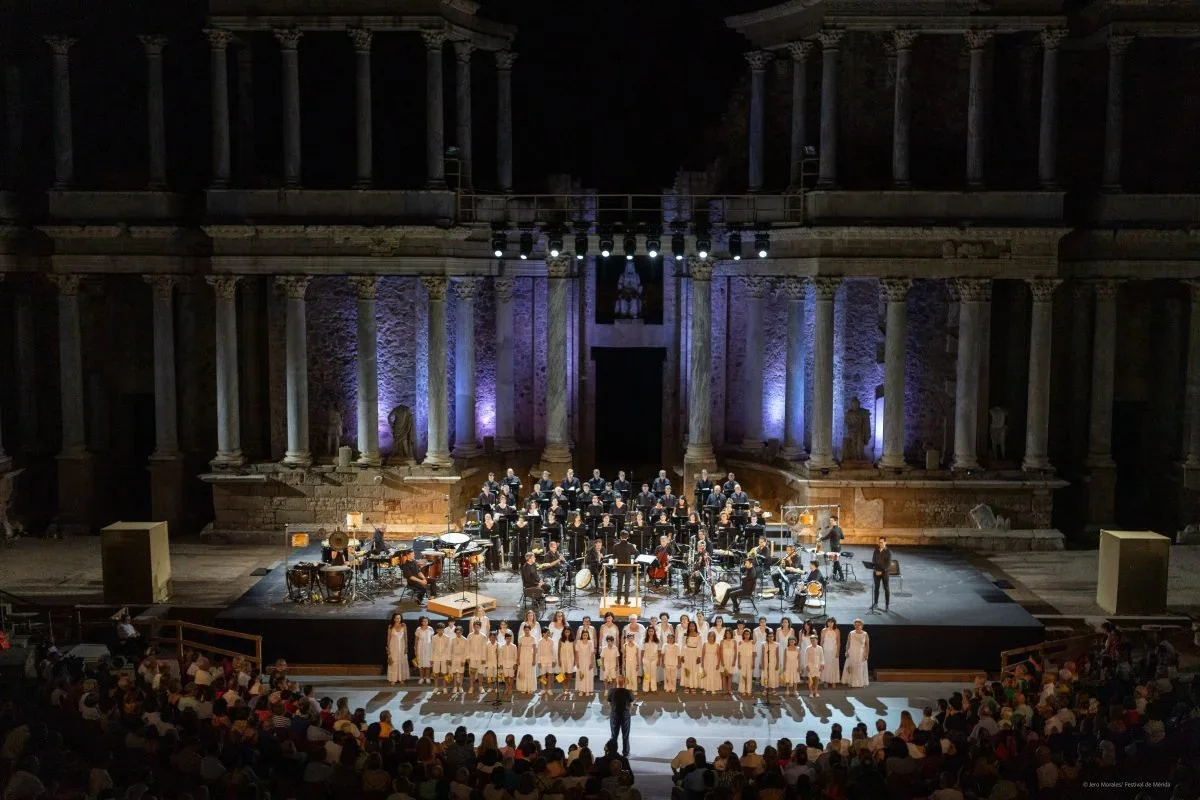
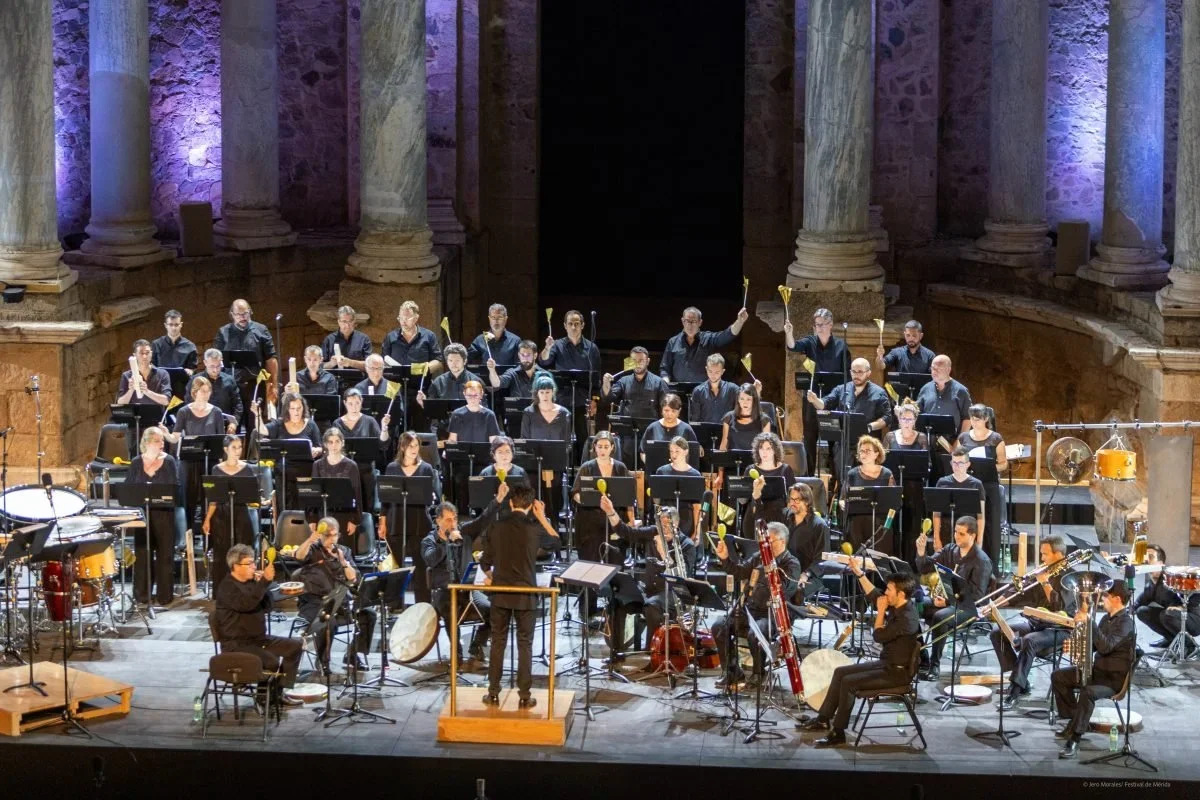
For this performance at the Mérida Festival, Grupo Enigma joined forces with Polish baritone Maciej Nerkowski and Ensemble Vocal Teselas, together with the Extremaduran children’s choir Coro Amadeus-IN and actor Simón Ferrero. Under the musical direction of Asier Puga, nearly one hundred performers brought to life a work that moves between the conflicts of Greek tragedy and those of twentieth-century Greece; between equilibrium and chaos; all framed by the atmosphere of a modern primitive ritual.
PROGRAMME
Iannis Xenakis (1922–2001)
Oresteïa (1965-1992)
Agamemnon
Kassandra (1987)
Agamemnon
Les Choéphores
La Déesse Athéna (1992)
Les Euménides
Duration: 75 minutes
ARTISTIC AND TECHNICAL TEAM
Maciej Nerkowski, baritone
César Peris, solo percussion
Simón Ferrero, actor
Ensemble Vocal Teselas, (Javier Garcés, director)
Coro Infantil Amadeus-IN (Alonso Gómez Gallego, director)
Grupo Enigma
Asier Puga, concept, text adaptation and musical direction
Pictures
Commentaries
31/07/2023
“This performance of Oresteïa has remained in my memory as one of the greatest concerts I have attended in the 21st century.”
“Xenakis himself often remarked that the most important thing when performing his music was how it sounded, rather than strict fidelity to what he had written (which had to be adapted to multiple performative variables). It seems evident that this was Asier Puga’s greatest achievement in his exemplary realization with Grupo Enigma, Ensemble Vocal Teselas, and the Amadeus-IN Children's Choir. Achieving that magic and sustaining it throughout the concert is the result of long and intense rehearsal periods, during which the conductor and musical coordinator earned the complete trust of each and every performer.”
MUNDO CLÁSICO, Xoán M. Carreira (critic) — Read the full review here.
04/07/2023
“Faced with an excellent—yet undoubtedly challenging—acoustic environment for the instruments, and with the risk that Xenakis’s radical poetics might have been diluted, Asier Puga delivered a taut interpretation of spasmodic energy, not even diminished by the narrator Simón Ferrero’s textual interpolations, who was effective in his contextualizing role.”
ÓPERA ACTUAL, Ismael G. Cabral (critic) — Read the full review here.